
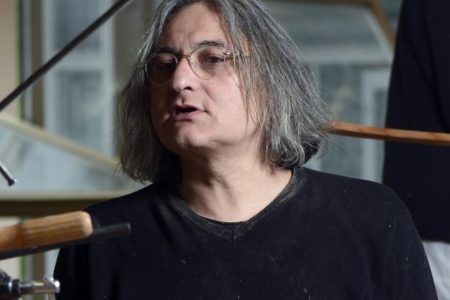
Lecture by Bernhard Rüdiger: “Faith Again” – November 4, 2026, Faculty of Fine Arts in Belgrade
On Wednesday, November 4, at 5 pm, the Faculty of Fine Arts in Belgrade (Pariska 16) will host a lecture by artist Bernhard Rüdiger titled Faith Again. The lecture is open to the public and takes place as part of the Erasmus+ Blended Intensive Programme Intersection, hosted by the University of Arts in Belgrade, with colleagues from ENSBA Lyon and TU Wien participating.
The artworks presented in the lecture engage with sound, vibrations, and the bodily experience of the visitor. Their aim is to shift the viewer from a passive to an active role, acknowledging that art is perceived through the whole body and not solely through the eyes. The lecture approaches art as a manifestation that cannot be isolated from historical forces (wars, violence, neoliberal capitalism, and natural disasters) and seeks to analyse how artistic forms are informed and shaped by these events.
The title was originally intended to be Failed Again (Seventh Trumpet), after a recent series of sculptures exploring lathing as a response to catastrophe. Having been transmitted orally in preparation for the lecture, it became Faith Again. As someone remarked, it could also have been Fate Again.
We are living in catastrophic times which, like the Seventh Trumpet of the Apocalypse, herald the end of time. Yet this apocalyptic temporality can also be read as an expansion of the present. The lecture proposes understanding our contemporary condition as an opportunity to apprehend the increasingly expanded present as a new form of depth, capable of transcending the stagnation of temporalities and our sense of being trapped between action and inaction.
In this expanded present, the question posed by the viewer before an artwork is no longer “What do I see?”, as it was in Western modernity, but “What should I see?” This is not merely a shift from aesthetics to ethics; it opens up a new dimension of time. Contemporary artwork is no longer simply the object we see; it also becomes a screen within our inner eye, projecting what we should see. This shift initiates a new process of reflection, understood both as thinking about something and as the mirroring of global power relations, invisible borders, violence, and the economy as the driving force behind contemporary conflicts.
About the speaker
Born in Rome in 1964, Bernhard Rüdiger has lived and worked in Paris since 1994. His work on space, sound, and the physical and perceptive experience of the body is nourished by theoretical reflection on the reality of the work and its historical responsibility. His work has been shown in numerous international institutions. An extensive monograph, Forty-Nine Exhibitions, published by Mousse in 2022, retraces his career. A retrospective, Bernhard Rüdiger: Failed Again, was presented at the Coastal Galleries Piran, Slovenia, in 2026.
A graduate of the Accademia di Belle Arti di Brera, where he studied with Luciano Fabro, he worked in Milan at La Casa degli artisti, founded by Fabro with Jole De Sanna and Hidetoshi Nagasawa (1978), and played an active part in the debate on the new Italian art scene in the late 1980s. With artists including Liliana Moro, Adriano Tovato, and Mario Airò, he collaborated on experimental collective projects before founding the magazine tiracorrendo and the Spazio di Via Lazzaro Palazzi (1989–94). In 2022, the Museo del Novecento in Milan created an archive devoted to this work, and a book on the project was published by Electa (Milan, 2022). Rüdiger co-founded the art center Volume! Un lavoro in Rome (1997/1998) with Alfredo Pirri, Jannis Kounellis, philosopher Pietro Montani, and architect Nicola di Battista. In 2004 he founded the research unit ACTH, Contemporary Art and Historical Temporalities, which he directs at the Art Academy ENSBA Lyon. A book of his theoretical texts, Horizon of Forms, The Living Languages of Contemporary Art, was published in the ACTH Artist’s Reflexion collection in 2024.
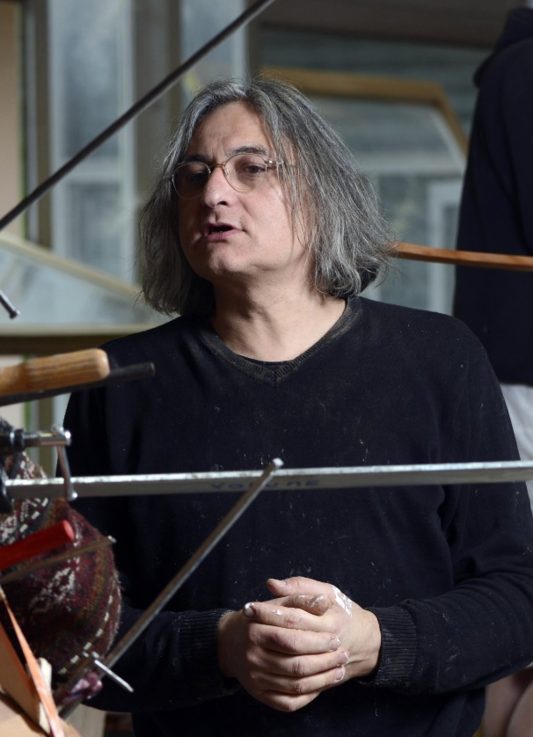
Photo credit: Luc Jennepin, Montpellier, 2015.