
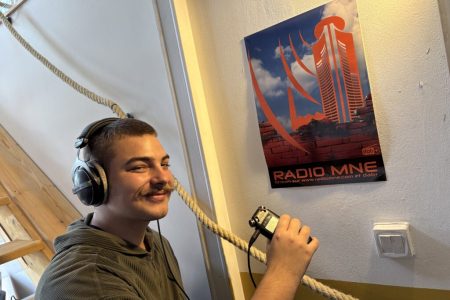
MY STUDENT TRAINEESHIP IN MULHOUSE: Ilija Stojković
Ilija Stojković
University of Arts in Belgrade, Faculty of Dramatic Arts
Erasmus+ Mobility for Traineeship at:
Radio MNE, Mulhouse
My exchange in France took place in Mulhouse, a city often described through the lens of post – industrial decline but, in practice, experienced as a space of active transformation. Rather than feeling situated on the margins of French cultural life, my time there gave me a strong sense of being present in an urban environment before it becomes widely recognized as “cool” – at a moment when renewal is underway but not yet fully codified, branded, or capitalized.
Mulhouse’s history as an industrial center remains visible in its architecture, urban layout, and social fabric. Former factories, workers’ neighborhoods, and infrastructural corridors form the backdrop to contemporary cultural initiatives, educational institutions, and civic redevelopment projects. Experiencing the city from within this transitional phase allowed me to observe how culture operates not as a decorative afterthought, but as a practical tool in reimagining urban identity, reuse of space, and public life.
Cultural venues, libraries, museums, and educational institutions functioned as everyday infrastructure rather than as tourist – oriented showcases. This created an environment where participation felt grounded and organic. The city’s scale made it possible to see how audiences form, how institutions adapt, and how artists and cultural workers interact with the city rather than merely pass through it.
Living in Mulhouse also sharpened my understanding of center–periphery dynamics in contemporary Europe. The proximity to Basel, Freiburg, and Strasbourg placed Mulhouse in a dense transnational network, yet without dissolving its local specificity. Instead of experiencing this positioning as marginal, it felt generative: Mulhouse operates as a testing ground where ideas circulate before they become stabilized or institutionalized elsewhere.
This experience resonated strongly with my broader interests in cultural ecosystems, publishing, and audio media that emerge outside established capitals. Being in Mulhouse reinforced the value of working in cities at an earlier stage of their cultural narrative – where experimentation is still possible, access is less mediated, and the relationship between culture, urban space, and social life remains visibly in flux.
In retrospect, my exchange in Mulhouse was defined less by distance from cultural centers than by temporal positioning. It offered the perspective of being early rather than peripheral, embedded in a city negotiating its future through culture, education, and transnational exchange. That experience continues to inform how I think about where meaningful cultural work happens – and when.