MY TEACHING MOBILITY IN TALLIN: Bojana Savić
Bojana Savić
University of Arts in Belgrade, Faculty of Applied Arts
Erasmus+ Mobility for Teaching at:
Estonian Academy of Arts in Tallinn (EKA)
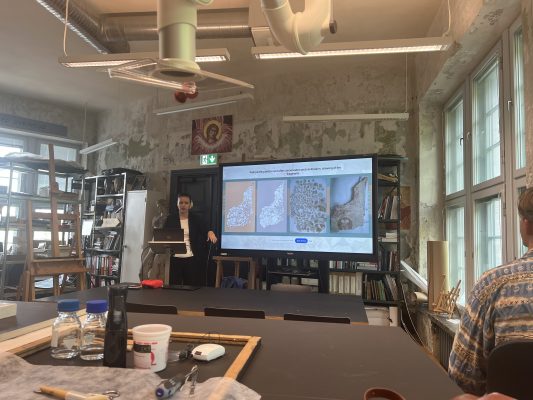
My mobility at the Estonian Academy of Arts (EKA) in Tallinn took place from June 1st to 6th, 2025. During this period I received invaluable support and warm hospitality from my host colleagues. I find the opportunity to present the work of the Department of Conservation and Restoration at the Faculty of Applied Arts in Belgrade, along with my teaching activities in the courses Basics of Conservation and Conservation and Restoration of Wall Paintings und Mosaics.
Particular interest was drawn to our hands-on work with students on the reconstruction of fragmented wall paintings from the Studenica Monastery and the Church of Palež. I also introduced the cultural heritage of Serbian monasteries and our fieldwork during the summer conservation school in Montenegro, which sparked fruitful discussion.
One of the highlights of my stay was attending the master’s thesis presentation by student Sofia Melikova, titled The Technical Replication of Fine Jewelry as a Strategy for its Conservation. The work, supervised by Professors Elin Figueriado and Hilkka Hiopp, was both enlightening and inspiring —especially considering that jewelry replication and restoration are not currently part of the curriculum at my faculty. It opened up new perspectives and possible areas for future course development.
Additionally, I visited the annual exhibition of EKA students, displayed across various sites throughout the city. It was a valuable opportunity to observe both the shared sensibilities and distinct differences in how our institutions conceive and present student work. This visual dialogue between traditions end contemporary expressions offered new insights into exhibition design and artistic communication.
My hosts were deeply engaged in comparing the structure and content of our conservation curricula, with the shared goal of establishing high-quality future mobility opportunities for both students and staff. We also explored the exciting prospect of co-organizing summer schools at various heritage sites—a step toward deeper international collaboration.
On the final day of my mobility, I joined my hosts and their students in situ at the 19th-century Kose-Uuemõisa manor house, where they were conducting investigative conservation work. It was an inspiring and educational experience that introduced me to different methodologies, which I am eager to incorporate into my own teaching and practice.
To conclude this enriching journey, we visited the sacred Siniallika springs —a remarkable natural phenomenon nestled in the forest. This peaceful encounter allowed me to experience aspects of Estonia’s intangible cultural heritage end reconnect with the spiritual and environmental dimensions of conservation.