SHARED RESOURCES FOR HEALTHY AND OPTIMAL PLAYING
Shared Resources for Healthy and Optimal Playing
Erasmus+ Blended Intensive Programme
In the period from 22.03.2026 to 27.03.2026, we had the opportunity to participate in the Erasmus+ programme “Shared Resources for Healthy and Optimal Playing”, implemented within the activities of the university alliance IN.TUNE. The programme took place in Vienna, Austria, at the University of Music and Performing Arts Vienna (MDW). It brought together students from Vienna, The Hague, Bucharest, Oslo, Freiburg, and Belgrade. The course was designed as a blended mobility programme, combining both online and in-person participation.
The programme was led by professors and experts from different disciplines related to music performance, psychology, and health. Conceived as a blended mobility program, it combined online preparatory sessions with an intensive week of workshops, lectures, discussions, and practical work centered around one essential question: how can artists truly learn to create, perform, and develop sustainably, without sacrificing their physical and mental well-being in the process?
For us, this program came at an incredibly important moment. In environments where musicians are often taught to constantly push through discomfort, ignore exhaustion, normalize anxiety, and equate self-worth with perfection, it was both moving and almost relieving to encounter a space where vulnerability, awareness, and balance were treated not as weaknesses, but as necessary foundations of professional development. Instead of focusing solely on technical achievement, the programme approached performance in a holistic way, through the body, mind, emotions, and the psychological processes that shape every performer on stage.
Throughout the programme, we attended lectures and workshops dedicated to performance anxiety, breathing, concentration, injury prevention, body awareness, healthy practicing habits, and mental preparation for concerts and auditions. What made these topics truly impactful was the way they were approached, not as distant academic concepts, but in a deeply human way. Many participants openly shared experiences of fear, physical pain, burnout, perfectionism, loss of confidence, and emotional pressure that often accompany musical work. In doing so, the programme created an atmosphere of honesty and trust that is rarely encountered within highly competitive environments.
As young musicians, this resonated with us profoundly. Like many performers, we have experienced moments in which fear and tension become physically embedded in the body, when overthinking affects breathing, when stress accumulates in muscles and posture, or when the pressure to constantly improve begins to distance us from the joy of making music itself. Because of this, the programme did not feel like just another educational course, but rather like a meaningful process of becoming aware of ourselves in a new way.
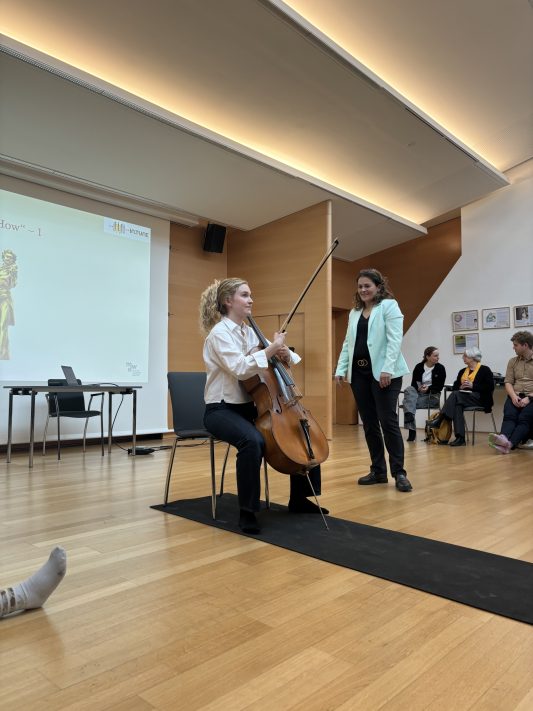
Particularly inspiring were the sessions dedicated to the Alexander Technique and the Timani method, through which we explored the relationship between anatomy, movement, sound production, and emotional state. These lectures and practical exercises gradually changed the way we perceive our bodies while performing. We became more conscious of unconscious physical habits, unnecessary tension, breathing patterns, and the ways in which mental states manifest physically during performance. What made this realization so powerful was understanding that artistic freedom and expression are inseparable from physical ease and inner balance.
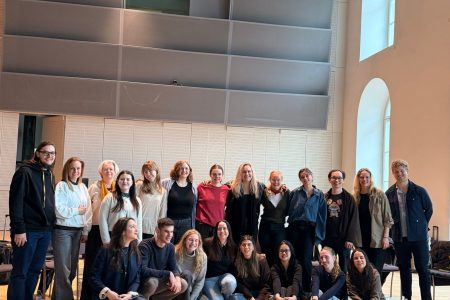
At the same time, the international character of the exchange added another important dimension to the experience. Spending time with students from different countries and backgrounds opened space for meaningful conversations not only about music and performance, but also about education systems, creative processes, fears, ambitions, and the realities of pursuing an artistic career today. Despite our differences, we quickly recognized how many struggles we all shared. That sense of mutual understanding transformed the group into a genuinely supportive community rather than merely a temporary academic gathering.
The atmosphere of Vienna itself, a city deeply shaped by art, music, and cultural history, additionally inspired and motivated us, making the entire experience feel even more meaningful and encouraging for our own professional growth.
What we will perhaps remember the most is the feeling the programme left behind, the reminder that artists are not machines designed only to produce results, but sensitive human beings whose work depends on their ability to remain connected to themselves.
For us, this experience was not only educational, but genuinely transformative. It gave us practical knowledge, new perspectives, and tools we will continue carrying into our future development, while also reminding us of the importance of protecting the very foundation from which music emerges: our mind, body, sensitivity, and love for music itself.
Mina Korać
Elena Medić