
Walks
Walks
Erasmus+ Blended Intensive Programme
The Erasmus+ BIP project “WALKS” is a collaboration between the National School of Fine Arts in Lyon (the project holder), the Institute of Art and Design of the Technical University of Vienna and the Faculty of Fine Arts of the University of Arts in Belgrade. The project was developed through a series of meetings in Belgrade and Lyon during 2024 and 2025, with the aim of creating a joint educational program. It was inspired by collective walks during student protests in Serbia. These peaceful actions, based on collective journeys and encounters with local communities, serve as a starting point for reflecting on the concept of place and its layered cultural memory. The program draws on the theoretical concepts of “inventing the site” (Robert Morris) and “overlay” (Lucy Lippard), understanding space as a set of visible and invisible layers that can be activated through artistic practices such as walking, mapping, and narration.
Program mentors: Thomas Boutoux, Bernhard Rüdiger (ENSBA Lyon); Marie Reichel, Julia Haugeneder (TU VIENNA); Svetlana Volic (FLU Belgrade).
Guest lecturers: Jelena Todorović, Nemanja Nikolić, Vladimir Bjeličić, Kamilla Wolszczak, Petra Unger, Natalie Bamford, Alessandra Prandin.
In addition to students from Vienna and Lyon, five students from the Faculty of Fine Arts participated in the program: Zorana Stevanović, Nada Tomić, Nevena Ostojić, Ana Mitrović and Đorđe Radović.
The virtual component of the program, realized from March 12 to 17, 2026, included lectures with mentors and guest professors, who set the theoretical and practical framework of the project.
Svetlana Volic gave an introductory lecture, about different artistic practices that use walking as a method, followed by different historical and philosophical contexts (Flannerism, Situationism, Psychogeography, Mapping, Art of Walking, Pilgrimages, Protests, etc. Part of the presentation related to examples of creative journeys during the 2024-2025 student protests in Serbia, where the act of walking became a tool for social and cultural change.
Jelena Todorović gave a lecture “The Way a City Remembers” presenting how a site-specific research could be incorporated into the teaching process, and how much the students learn from this intertwining of artistic and scholarly approaches. She presented examples of the series of interdisciplinary workshops held at the Faculty of Fine Arts and University of the Arts in Belgrade (2014-2019). The subject of them all was the urban space and the process of remembrance and forgetting (both willing and unwilling) that is ingrained into the fabric of the city.
Nemanja Nikolić presented independent artistic initiatives in Belgrade, which address the problem of lack of spaces for artists. He showed examples of good practice in the temporary use of abandoned industrial heritage buildings, but also the lack of support from the city authorities for the sustainability of such processes. He also presented the work of the independent art center U10, as one of its founders. Alessandra Prandin, director of CAP Saint-Fonds, added to this topic very well. She presented the example of the forty-year successful existence of this independent art center in the industrial zone of Lyon.
Petra Unger presented her walking practice, as a method for uncovering the layered cultural memory of a place, in terms of a feminist perspective on how public space is used, remembered and narrated. As the creator of the “Vienna Women’s Walks”, she designs and leads city walks that explore Vienna’s history and public spaces from the perspective of women and their often overlooked stories.
Natalie Bamford presented her and Simon King’s paper “Bringing into conversation two walking practices to explore the palimpsest of space” from the book “Walking as a Research Practice”. By traversing the urban landscape of Newcastle together, they investigated the concept of space as a palimpsest, where layers of history and personal memory are uncovered through movement. Their collaborative journey illustrates how walking as research can foster a “correspondence” between individuals, blending insider and outsider perspectives to reveal hidden rhythms of the built environment. Natalie also conducted a short online workshop for students, based on their methodologies, followed by virtual student walks through Lyon, Vienna and Belgrade.
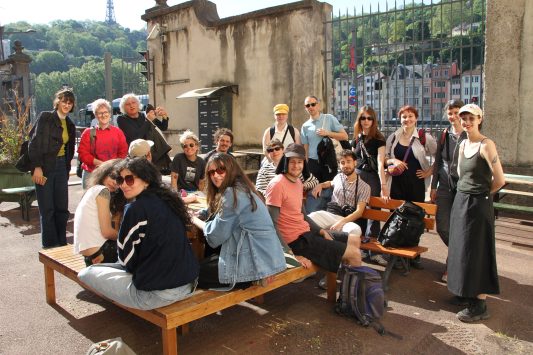
The physical component in Lyon took place from April 20 to 24, 2026, and consisted of a workshop and a series of collective walks through the city, with an emphasis on the embodied experience of spatial perception and reflection on the role of art in public space.
Guest lecturer Kamilla Wolszczak conducted a collective performative workshop “Walk with Speculative Artifacts”. The workshop focused on micro perspective and details in space with the aim of observing other relationships, opening up our bodily sensations and connecting with our imagination. Discovering narratives that help us imagine worlds with multiple meanings and become able to respond to the situation we find ourselves in.
On the occasion of BIP WALKS, Vladimir Bjeličić presented a lecture-performance “Walking Trees”, focusing on possible plant resistance strategies. By activating both personal and speculative narratives in motion, Vladimir constructed a dense, site-specific narrative, incorporating words, sounds, and images, with the aim of providing a socio-politically charged response to the growing forms of authoritarianism, colonialism, and militarism prevalent today.
The program in Lyon culminated with a day-long walk to the CAP Saint-Fonds art center, located on the outskirts of Lyon in the industrial part of the city, where a final pop-up exhibition was held with presentations and interactive performances.
Impressions about the project:
“The most interesting part of the WALKS project was the process of walking and getting to know colleagues from other schools and colleagues. As well as a long walk which lasted several hours that the hosts took us from the center of Lyon to the outskirts of the city. That part of the city used to be the center of the industrial zone, and today the abandoned premises of the factory have been turned into a cultural center. Joint walks connected us with other artists in a specific way and opened and showed us a picture of a city from a different perspective, first of all colored by new acquaintances and friendships, which enriched us all. Getting to know walking as an artistic practice led me to consider visiting various locations in Serbia, those featured in archival photographs that I found and which I plan to exhibit as part of my doctoral art project.” (Ana)
“The excellently organized dynamic rhythm allowed all participants to quickly open up and make friends, thus creating the best sense of community. I gained a new way of perceiving the space and with that act I significantly enriched my artistic practice. Personally, the biggest impression on me was Kamilla Wolszczak’s workshop, through which I activated various senses, so that by walking around Lyon with that approach, I got a more complete and deeper experience of the city. The conversations with other participants, professors and guest artists meant a lot to me because through formal and informal conversations excellent recommendations for various artists, books, films and museums were shared. By combining a theoretically rich online segment with a physically presence and intensive practical part, WALKS in Lyon is an excellent first step of the great walking program and I look forward to its next stage.” (Nada)
“The Erasmus BIP program WALKS allowed me to experience first-hand a different educational program than the one we have in Serbia. It was short lived, but still useful and invigorating. In a certain way, I broadened my horizons, what art and artistic research can look like”. (Nevena)
“What I enjoyed the most on the programme was the inspiration and energy one can get from group walks and workshops. Not only did I get new acquaintances, but I also got to share my views and ways in art, while connecting with people from other backgrounds and also exploring a city that shines with light what makes the rivers sparkle”. (Zorana)
“The WALKS project was very useful, inspiring and educational. During that short and intensive program, I exchanged a large number of opinions and views on the world and art with colleagues from other countries. After this experience, my view of walking as an artistic practice has been greatly experientially enriched. That experience was for me, both on the artistic and personal level, a rich treasury of new ideas, observations and discoveries. The landscape of Lyon carries great history and traces of past times, and its soil is a large interactive mosaic of footprints, on which we also moved a few pebbles while walking. (Đorđe)
We look forward to continuing the project in Belgrade and Vienna.
Zorana Stevanović
Nada Tomić
Nevena Ostojić
Ana Mitrović
Đorđe Radović
Svetlana Volic